
Grand Corruption: Theory
Leading experts are using the right theory, but misapplying it.

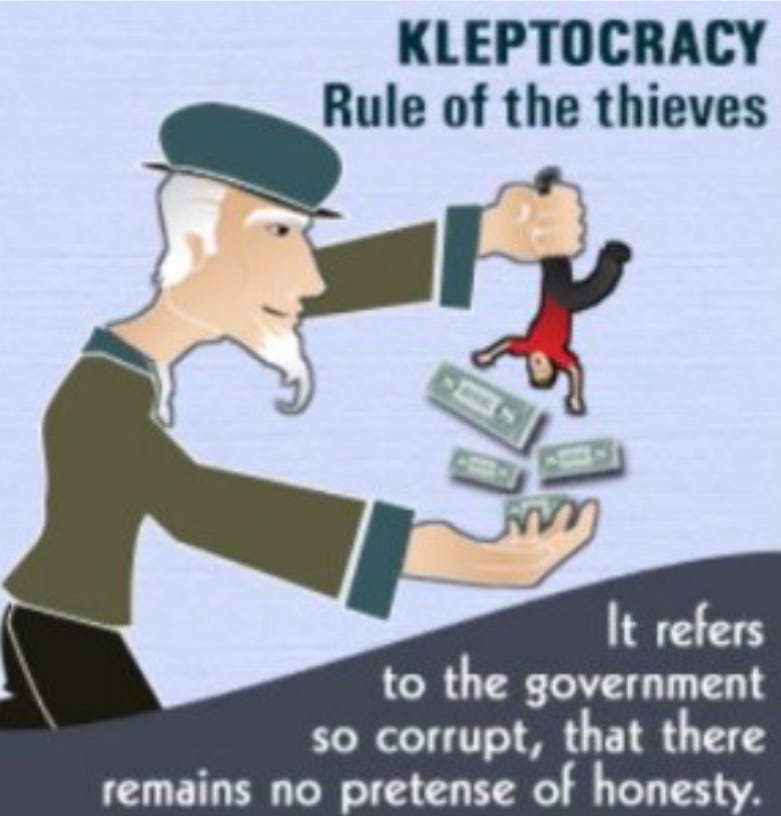
Leading experts say that development assistance will do no good in the fight against grand corruption until a country’s population first rises up on its own to depose their kleptocrats. That reflects a poor understanding of what “development” really is.
What is a Kleptocracy?
The kleptocracy, a prominent form of grand corruption, is by now reasonably well understood: A group of people captures a country’s government, then manipulates it for their own personal gain rather than for the public good. We call them “kleptocrats”, from the Greek word for thief.
Kleptocracies are empowered and sustained by a web of institutions, formed into systems. Included are typically the legal system and judiciary as well as things like commercial codes and, perhaps most importantly, operating rules and procedures governing the actions of official security services. Because they have captured the government, the kleptocrats can manipulate these and other systems to their own advantage, including to protect themselves from any opposition.
After capturing their country, the kleptocrats then amass great wealth, typically from taxes and from commercial activities. They use part of that wealth to strengthen and to buy the loyalty of security services — police, the army, etc. — to assure that they then can continue to amass great wealth, in turn to continue paying the security services, and so on. In other words, the various systems of institutions in the typical kleptocratic state are in balance, stable.
Theorists call this a state of equilibrium. To dislodge this equilibrium and then to replace the kleptocracy with something more likely to serve the public good is not easy.
What the Experts Say
Any small or incremental efforts mounted by those suffering within a kleptocracy will be unsuccessful because they will be supressed, perhaps brutally, by the security forces of the kleptocrats. The experts say that the only way to dislodge kleptocrats is with a substantial shock to the systems of institutions that sustain them. These experts nickname this kind of shock a “big bang”:
[I]t is not possible to sustainably dismantle and replace kleptocracy through incremental technical improvements. Overcoming the resistance of spoilers and breaking through the widespread expectations that “everyone is corrupt” can only happen amid the disequilibrium of “big bangs,” which bring about transformational political will… They cannot be driven by politicians, champions, or any other individual reformers. Rather, windows for dekleptification are ushered in by historic waves of nationwide popular demand, usually fueled by decades of frustration with kleptocracy. They may be triggered by some salient betrayal of public trust. Aggrieved masses pour into the streets or to the ballot boxes in record numbers. The window is typically not fully open until a kleptocratic regime gives way to a new reformist government.
[USAID, September 2022. Dekleptification Guide: Seizing Windows of Opportunity to Dismantle Kleptocracy.]
Theory and the Case of Sweden
The footnotes to the USAID Dekleptification Guide suggest that its underlying theory is based at least in part upon a paper by Bo Rothstein in the Review of International Political Economy in 2011, entitled “Anti-Corruption: The Indirect ‘Big Bang’ Approach”. The paper takes as an example the case of Sweden in the 1800s.
In those days, Russia invaded Sweden. Russia’s objective was to force Sweden to join Emporer Napolean’s boycott of trade with Britain, France’s greatest adversary. Sweden was ill prepared for this war because those in charge of its goverment, the king and allied nobles, were incompetent, focused mostly on enriching themselves rather than on providing for the common defense. As a consequence of this incompetence, Sweden was soon defeated, losing to Russia half of its territory, the part known today as Finland, which had until then been producing lots of tax revenue for the king and his allied nobles.
The “big bang” in this case was the loss of Finland and its revenue, and perhaps just as importantly, it was the loss of the belief that the king and his allied nobles were capable of protecting Sweden against future losses. Confronting their sudden loss of wealth, and feeling vulnerable to outside invaders, the more “liberal” of the nobles of Sweden deposed their king and sent him into exile. They then replaced their country’s political system with a constitutional monarchy, which they hoped would be more capable of defending Sweden henceforth.
The Rothstein theory of fundamental institutional change hypothesizes that the liberal nobles would not have been able to transform their country’s fundamental governance institutions without there first having occurred the big bang. Prior to this, the king would have been too powerful. Sweden was in a state of equilibrium before the war, but the big bang dislodged that equilibrium, permitting the emboldened liberal nobles to build a sufficient coalition that could challenge the king successfully.
I generally concur with this theory. It is with the theory’s application that I take issue.
How the Experts Apply the Theory
Drawing on Rothstein’s theory of fundamental institutional change, the USAID Dekleptification Guide proposes the kind of equivalent big bang that would typically be necessary to dislodge a modern-day kleptocracy. Importantly, they do not suggest that the country of a kleptocracy should be invaded in the way that Russia invaded Sweden. Given modern respect for national sovereignty, this cannot be their recommended strategy.
Rather, the only effective big bang they foresee is for the population of the country itself to become enraged by the thefts of the kleptocracy, and by the violent supression by security forces of any opposition. The population (“aggrieved masses”) then mounts a peaceful revolution (“to the ballot box”) or perhaps a violent one (“pour into the streets”). Then and only then does a window of opportunity open up through which USAID can enter to provide development assistance.
Note the sequencing: The revolt happens first. Only then can development assistance begin.
Theory and the Case of Cuba
The case of Cuba in the 1950s is arguably more pertinent. It has the added benefit of opening the theory to a broader application, one where development assistance might very well prevent the catastrophe that typically accompanies violent revolution.
Instead of a king, Cuba had a president, Fulgencio Batista. With his allies, Batista pocketed millions in payments from the American companies that were doing a highly profitable business in Cuba. One of the most famous gifts was a gold-plated telephone from the American telephone company that operated its network in Cuba. That gold telephone sits today in a museum in Cuba.
Batista used his security forces to suppress opposition. Most famously, a branch of those security forces trained by the American Central Intelligence Agency employed torture, executions, and the indiscriminate shooting into crowds of protestors to maintain Batista’s control.
In a non-kleptocracy, we would expect the money paid by American companies doing business in Cuba to be deposited into the country’s treasury, then to be used for public purposes such as roads, electricity production, water systems, schools, or hospitals. Instead, there was little money in the Cuban treasury for these things because Batista and his allies were enriching themselves.
Poverty was widespread, and even Cuba’s merchant and professional classes felt they were being left behind. They became angry. There were protests and demonstrations. Famously, at one of these demonstrations led by students, the country’s security forces, seeking to protect Batista’s cash flow and thus their own access to generous salaries, opened fire. Many students were killed.
We may consider this to be Cuba’s “big bang”, fundamentally changing the hearts and minds of Cuba’s population. More and more support from the general public was afforded to paramilitary forces active in the countryside in opposition to Batista’s regime. There were attacks and counterattacks. Many were killed.
Batista and his allies were eventually overwhelmed and forced to flee into exile, an event famously featured in the film Godfather II, but of course they also took along sacks of cash totalling in the millions. A young U.S. senator, John F. Kennedy, called attention to this debacle while he was campaigning for the presidency in 1960.
An Alternative Application of the Theory
In some ways the cases of Sweden and Cuba are similar. In both, it took a big bang to dislodge an entrenched, seemingly stable governing group who amassed fortunes for themselves while failing to act in the best interests of their country. Both are actual cases from history.
In the Cuba case, however, there is the added complication of the involvement by American businesses. Modern kleptocracies might of course invite the involvement of multi-national businesses from just about anywhere, not just America.
The authors of USAID’s Kleptocracy Guide focused on the case of Sweden as their guide. From that example, they perceived only one real option: waiting for a revolution to occur. It would be better, I submit, to focus on the Cuba case, where an additional possibility presents itself.
What if, years before the Cuban Revolution, the cash flow to the Batista regime had been cut off? What if the United States had somehow been persuaded to stop its companies from doing further business in Cuba?
Why would the United States have done this? Could the United States have anticipated the national security implications of a successful violent revolution in Cuba?
The Way Forward
Rothstein’s underlying theory of fundamental institutional change is sound. The application of it by the authors of USAID’s Kleptocracy Guide is overly narrow. We need not wait for the situation in a country to deteriorate to such an extent that revolution, typically destructive and violent, becomes the only viable option in the eyes of a country’s population. A strategy that targets the businesses that line the pockets of kleptocrats is arguably the better option.
After the Cuban Revolution, President Kennedy witnessed the Cuban confiscation of American properties and Cuba’s growing alliance with the Soviet Union along with the spread of communism threatening to overwhelm America itself. It was because of this that President Kennedy moved quickly to create USAID in 1961.
The expressed purpose of USAID was to prevent violent revolutions, with their anticipated adverse consequences to the United States, by providing development assistance. However, the tools granted to USAID were never adequate to the task, and became even less effective over time as the very mission of USAID was distorted and overlain with contradictory mandates. Most importantly, the leadership of USAID in those early days did not truly understand what “development” was all about.
Over a career spanning 30 years, I often asked my superiors at USAID and in think tanks and research institutions to define “development”. The answers were never satisfactory, often muddled. It was one of those “you’ll know it when you see it” sort of things.
Here’s a clarified definition, which is from the new “Act for International Development”:
(a) For the purposes of this Act, the term “development” means the favorable transformation of economic, political, and social institutions, where favorability is judged to the extent that the transformation results in greater numbers of people who are able to escape poverty and to achieve prosperity.
(b) The term “institution” refers to enduring formal and informal practices, understandings, rules, regulations, and laws, at any level of society or government, not to be confused with an institution in the sense of an “organization” that is itself a bundled set of institutions governing and/or guiding action for an enduring purpose.
The new Act for International Development updates the tools for development available to USAID, and clarifies the mission. The essays that follow will explain how that will work in practice.
Upcoming Essays
2. Grand Corruption: Follow the Money
The greatest mistake analysts make when considering how best to address grand corruption in a developing country is their failure to look in a mirror. Development assistance isn’t merely something we “do” to poor countries. We are often very much part of the problem.
3. Grand Corruption: The National Security Risk
Grand corruption puts us all in danger. Violent extremists target us because we are associated with those corrupt international business interests that make poverty worse. Migrants enter our country using irregular methods because grand corruption leaves them little alternative.
4. Grand Corruption: A Coordinated Response
The USAID mission director steers U.S. assistance within a developing country, but is assisted by the Office of Development Coordination outside that country. The hypothetical case is offered for how the outcome in Cuba in the 1950s might have turned out differently.
5. Grand Corruption: Countering Opposition at Home
Rest assured, many of America’s most powerful corporations will oppose development assistance when it is structured this way. Yet many other American businesses will welcome it. We may do well to play one set against the other.
6. Grand Corruption: USAID on the President’s Cabinet
The Departments of Commerce, Agriculture, and State aren’t accustomed to thinking this way. To help them evolve and then to make the case to the President, USAID needs to be in the room.